Your Café Business Plan
Find out if your café business stacks up before you sign the lease.
I'll guide you step by step through creating a proper café business plan, including a full set of numbers and a strategy you can stand behind.
Instant access. Start today and work at your own pace. 14-day refund.
The first 20 buyers also get a video review of their finished plan from me.
- 25+ years in coffee
- Operations and product development at Gloria Jean's
- Opened and sold my own café
- 10 years working with hundreds of independent cafés
Most café plans are written backwards
I've been in coffee for more than 25 years, and I've watched it happen more times than I'd like to count.
It usually starts the same way. Someone falls in love with a site, a fit-out or a menu idea. Then they open a template and try to make the numbers agree with a decision they've already made.
You fix it by changing the order. Goals first. Then evidence from your actual area. Then a strategy built on that evidence. Then all the detail everyone wants to jump to: the site, the menu, the fit-out.

There are three ways to write a café plan
A template leaves you guessing. A consultant leaves you holding someone else's plan. This one leaves you with a plan you built yourself, and can defend.
"Why not just ask ChatGPT to write it?"
Sure, you can ask an AI tool, and you'll get a well-written, professional-looking plan.
The catch is that AI is trained on the average, and will give you a plan that looks like every other struggling café business plan out there.
The solution is to find the opportunities others in your local area are missing, and there's no average answer to that.
So yes, we use AI. Each week comes with a ready-to-paste prompt for the grunt work: desk research, first drafts, and checking your numbers against benchmarks. It's optional every time, and the free versions of the tools are fine.
We use AI for the work, not the thinking.
Every week ends with something written down
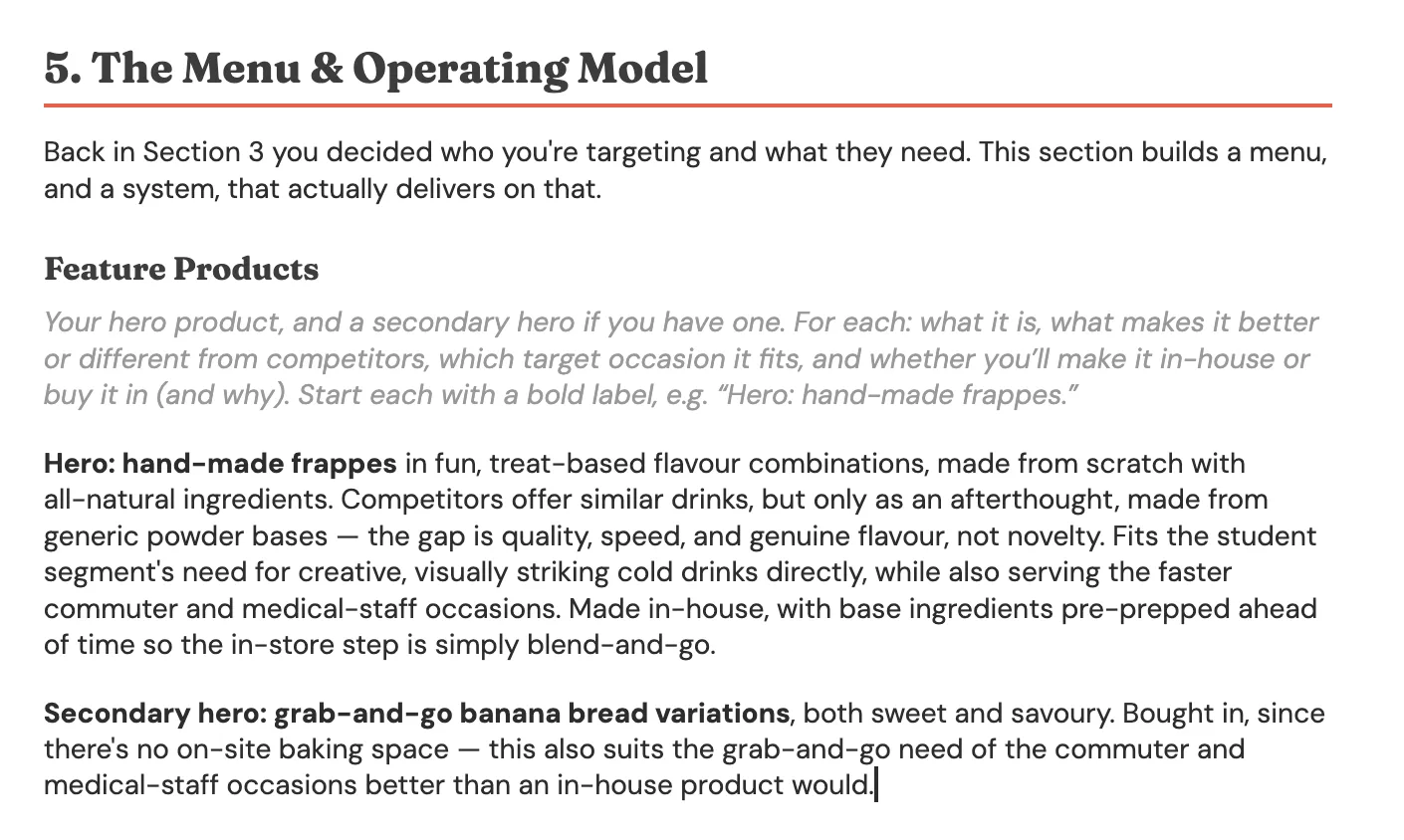
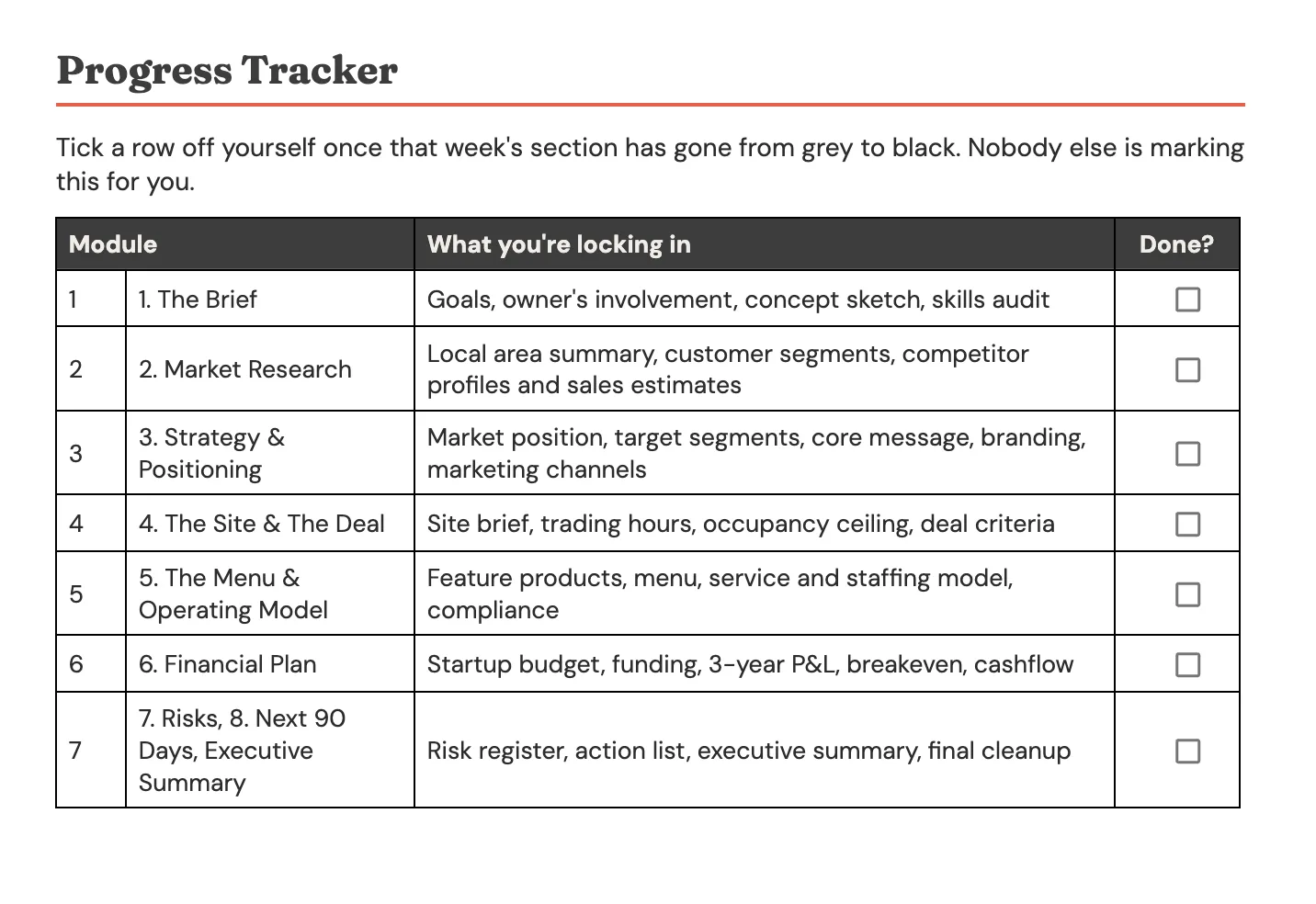
One rule runs through all six weeks. Every lesson gets something written into your plan. If nothing's changed in your Doc, the week isn't finished.
Your plan Doc starts in grey italics. That's me: a prompt, an example, and what "good enough" looks like. You write your version underneath in black. When a section's gone from grey to black, it's done.
By the end you'll have:
Your Café Business Plan. Nine sections, from your brief and market research through to your risks, executive summary and next 90 days. Plus a version ready to put in front of a lender or landlord.
Your Numbers. A ten-tab spreadsheet covering menu costing, wages, startup budget, a three-year P&L, two breakeven figures and a 12-month cashflow. Ready for your accountant.
Feedback on your plan. When you finish, post your plan in the chat and I'll come back to you with feedback. The first 20 buyers also get a video review.

Three checkpoints, three honest answers
-
Checkpoint 1, Week 2: Is there room here?
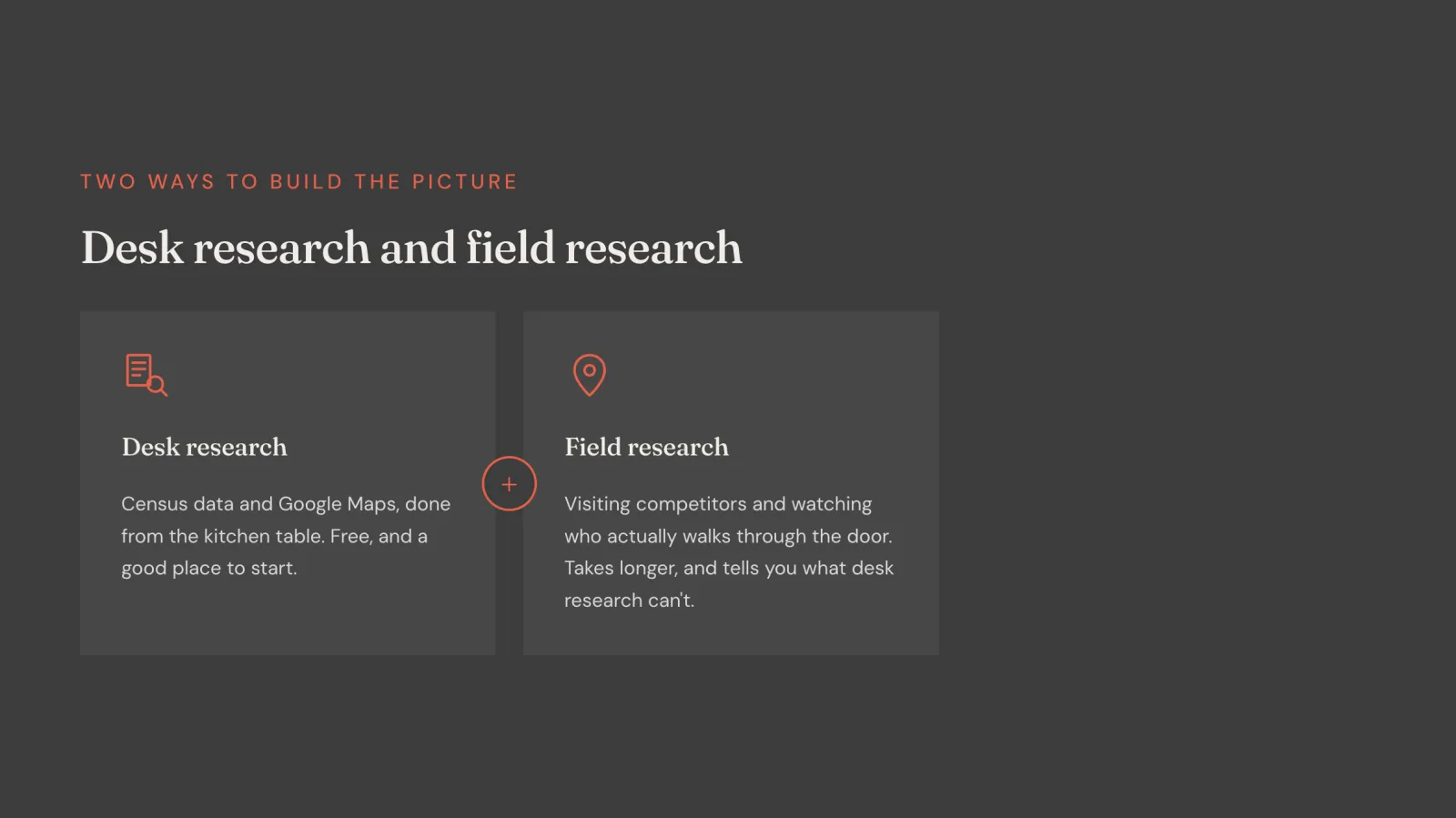
You've sat in the local cafés and watched who comes in and why. If someone's already nailing the occasion you planned to target, you find out now.
-
Checkpoint 2, Week 4: Does the deal work at your ceiling?
You've set the most you can pay in rent and outgoings. If every site you look at blows past it, that tells you something about the market you've picked.
-
Checkpoint 3, Week 6: Does it clear your number?
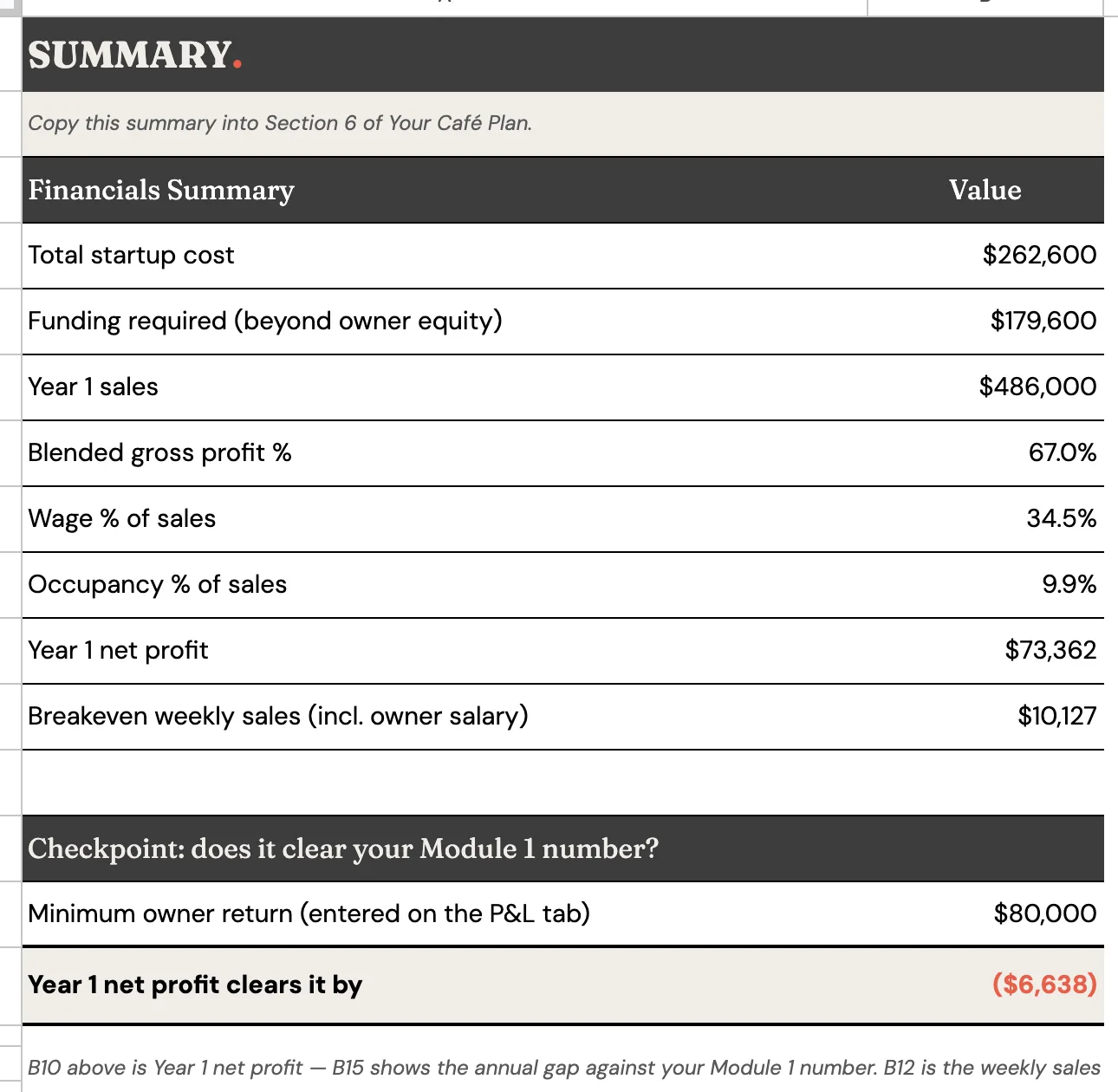
In week one you work out the minimum this café has to pay you. By week six the numbers either clear it or they don't.
The example café in the plan makes $73,362 in year one. Its owner needs $80,000. It falls short by $6,638, and the Sheet shows it in red.
A no at any of these is a good result. Finding out now costs you six weeks. Finding out after you've signed costs a lot more.
Week by week
Start Here (15 min) What you work onSet up your plan Doc and Numbers Sheet
Week 1: The Brief What you work onYour goals, your skills, build or buy
Week 2: Market Research What you work onYour local area, desk research, competitor café visits
Week 3: Strategy & Positioning What you work onPicking your lane
Week 4: The Site & The Deal What you work onSites, leases, and buying an existing café
Week 5: The Menu & Operating Model What you work onMenu, pricing, service and staffing
Week 6: The Numbers What you work onStartup costs, forecast, P&L, cashflow
The Final Plan What you work onPulling it together and pressure-testing it
Is this for you?
It's for you if:
- You're planning to open in the next 6 to 18 months
- You're still deciding, and want a real test before you commit
- You know hospitality from the floor, but not the business side
- You're buying an existing café rather than building one. Wherever the path splits, you'll know which part is yours
It's not for you if:
- You already run an established café, or several
- You want someone to write the plan for you
- You can't find about three hours a week

Who's guiding you
I've been in coffee since the late 90s. I started as a barista at Gloria Jean's and worked my way through store management into operations and product development.
Then I opened my own café, One Tree Coffee, from scratch. I wrote the plan, built the menu and the systems, made my share of mistakes, and eventually sold it.
After that I spent about ten years as Head of Trade Marketing at Seven Miles Coffee Roasters, working with hundreds of independent cafés. So I've seen these businesses from both sides of the counter, as an operator and as a supplier.
How it works
-
Video-led and self-paced. Start today and finish on your own schedule. Six weeks is the plan, but nobody's chasing you.
-
About three hours a week. Weeks two and six take more, and you'll know that going in.
-
Each week has a video, a summary of what to write into your plan, an AI prompt, and any checklists or templates you need.
-
Your plan and numbers are yours. You download them as Word and Excel files, so they're on your computer or in your Google Drive, not locked in a course.
-
It all sits in a private online space with places to ask questions, post your checkpoint calls and get feedback on your plan.
-
Access for as long as the course runs. Come back to the videos and templates whenever you need them.
Questions?
Do I need hospitality experience?
No. Week one includes a skills audit, where you work out your gaps and how you'll fill them. If you've worked in cafés already, this fills in the business side.
What if I decide not to open?
Then the plan has done its job. Finding out before you sign anything is the cheapest way to find out.
Is this only for Australia?
The examples and benchmarks are Australian, and the price is in Australian dollars. The method works anywhere. You'll plug in your own local numbers, and week two includes free data sources for Australia, New Zealand, the US, the UK, Canada and Europe, plus how to find the equivalent anywhere else.
I'm buying an existing café. Is it still relevant?
Yes. Most planning advice assumes you're starting with an empty shell. From week one you're planning for buying, not building, and week four covers the questions to ask the seller and the numbers to check before you hand over any money.
Will this get me a bank loan?
It gives you a finished plan and a version written for a lender or landlord. No plan can guarantee a loan. Lenders will also look at your deposit, your security and your history, and your accountant should check the numbers before you send anything.
Do I need to pay for AI tools?
No. The free versions are fine, and every prompt is optional.
How long do I have access?
For as long as the course runs. Your plan Doc and Numbers Sheet are files you download, so they're yours to keep regardless.
What if it's not for me?
Email me within 14 days of buying and I'll give you a full refund.
Find out now, or find out with the lease signed
In this plan the rent gets tested against a ceiling you set in week four. The sales forecast gets stress-tested at 20% under. And the whole thing has to clear the number you set in week one.
Six weeks, was $297 now $197$297, and you'll know.
Founding price ends Saturday 14 November, midnight (Sydney time).
Instant access · 14-day refund · First 20 buyers get a video review
Not ready yet? Try the free Café Profit Calculator and see what a café like yours could make.